

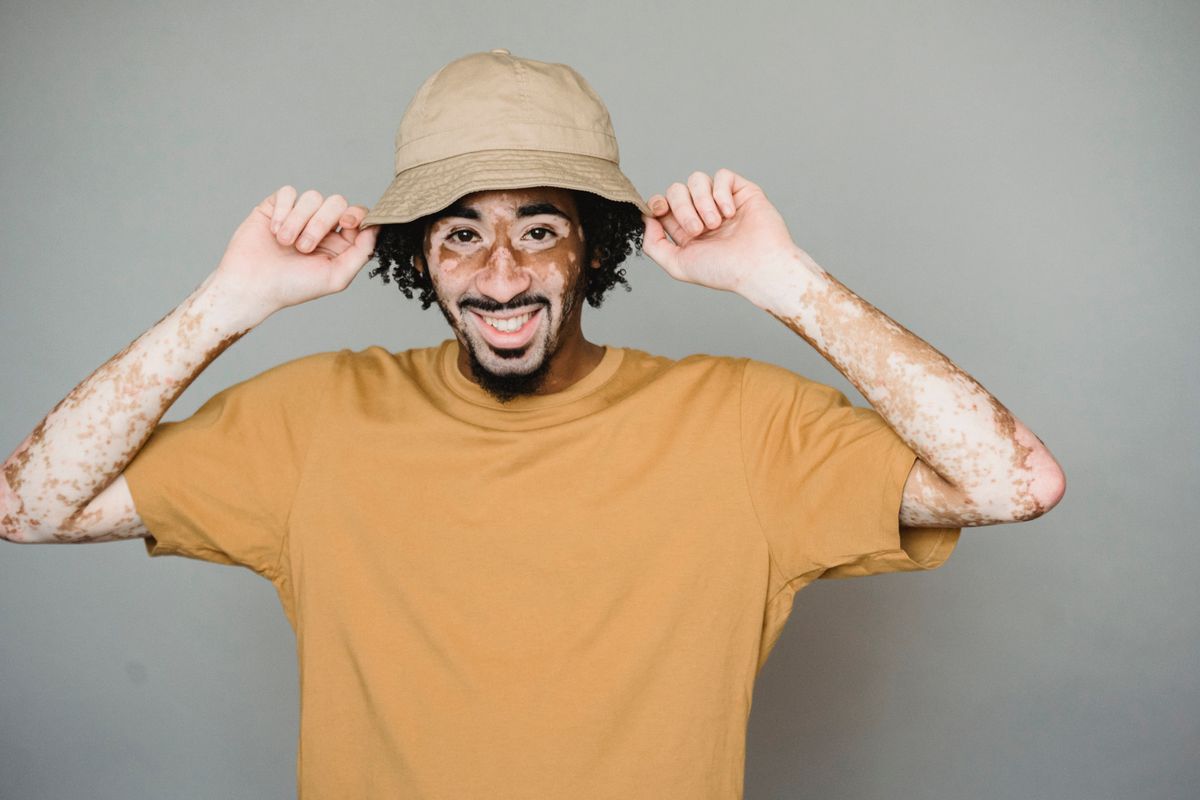
Can Vitiligo Be Treated?
Direct answer: Yes. Vitiligo cannot yet be cured, but it can often be managed, and many people regain some or much of their lost colour. Options include prescription creams, light therapy (phototherapy), newer JAK-inhibitor creams, skin grafting for stable patches and cosmetic camouflage. Results take months: the face and neck usually respond best, while the hands and feet respond least.
An autoimmune condition that removes pigment; completely non-contagious.
Usually several months of consistent, structured clinical care.
Face and neck respond best; extremities respond slowest.
Vitiligo is a difference in pigment, not a flaw. Treatment is always a personal choice.
Noticing a pale patch on your skin, or on your child’s, can be frightening, especially when relatives and neighbours offer their own explanations. Vitiligo affects roughly 0.5 to 2% of people worldwide, across every skin tone. On brown and black skin the contrast is more visible, which is one reason it causes so much worry in Uganda and South Sudan.
There is more reason for hope than many people are told. This guide explains what vitiligo is, clears up common myths, and walks through the treatments that can restore colour, how long they take and where to find support. Whether you choose to treat it at all is entirely up to you.
What vitiligo is, and what it is not
In vitiligo, the immune system mistakenly attacks melanocytes, the specialized cells that produce pigment (melanin). Without them, patches of skin turn chalky or milky white. Vitiligo is an absence of pigment, not a sign of structural skin damage: the skin within a patch is otherwise completely healthy and functional.
Common myths, answered
False: You cannot catch vitiligo by touching, hugging, shaking hands, or sharing food, cups, clothing or a bed.
False: Eating fish with milk, sour foods or citrus does not cause vitiligo, and no restrictive dietary regime cures it.
False: Leprosy is a bacterial infection whose patches are typically hypopigmented (paler) rather than pure chalk-white, and are usually numb. Vitiligo patches retain normal sensation.
False: It is a documented medical autoimmune condition, in the same biological family as thyroiditis, type 1 diabetes or alopecia areata.
False: Albinism is a genetic condition present from birth that affects whole-body melanin synthesis; vitiligo develops later in life in distinct patches.
Types and causes of vitiligo
There are five main presentations: segmental (unilateral, restricted to one side of the body, typically beginning in youth and stabilising quickly), non-segmental (the most common form, appearing symmetrically on both sides of the body), localised or focal (isolated patches in one zone), trichrome (three distinct shades with an intermediate zone of light pigment) and universal (depigmentation across most of the surface area).
Genetic susceptibility plays an important part, though environmental triggers often initiate the flare. Vitiligo is statistically more frequent in people with co-existing autoimmune disorders, particularly thyroid disease, which is why your physician may request routine endocrine blood panels. Other conditions also cause light spots, notably fungal tinea versicolor (pityriasis versicolor), so clinical evaluation with a Wood’s lamp (UV diagnostic light) ensures an accurate diagnosis.
Treatments that can restore colour
Clinical therapy focuses on two key goals: stopping active disease progression and stimulating melanocytes to produce melanin again (repigmentation). Many protocols combine topical and light-based therapies.
Creams and ointments
Topical corticosteroids calm localized immune activity and are often the initial step for small trunk or limb patches. Treatment courses are strictly monitored to avoid cutaneous thinning (atrophy). Topical calcineurin inhibitors (such as tacrolimus and pimecrolimus) suppress localized immune response without thinning delicate skin, making them ideal for the face, eyelids and neck.
JAK-inhibitor creams
Janus kinase (JAK) inhibitors represent a significant medical breakthrough. They disrupt intracellular signalling pathways that drive autoimmune destruction of melanocytes. Topical ruxolitinib is FDA- and EMA-approved for non-segmental vitiligo, demonstrating remarkable facial repigmentation in clinical trials over 6 to 12 months. While not yet locally registered in Uganda, our physicians can guide patients on safe overseas procurement when clinically indicated.
Phototherapy (NB-UVB)
Narrowband Ultraviolet B (NB-UVB) phototherapy delivers a precise wavelength (311 nm) that stimulates dormant melanocytes in hair follicles while dampening cutaneous inflammation. Sessions are typically administered 2 to 3 times weekly. At Refine, hospital-grade NB-UVB phototherapy is available at our flagship clinic at Forest Mall, Lugogo.
Surgical grafting
For stable vitiligo (patches that have shown no enlargement or new spots for at least 12 months), surgical cell transplantation or punch grafting can transfer active melanocytes from pigmented donor zones into depigmented patches. This is especially useful for segmental vitiligo.
Cosmetic camouflage
Waterproof, medical-grade cover creams precisely tinted to your natural complexion provide immediate, temporary concealment for important occasions or everyday confidence, safely used alongside active treatments.
| Treatment | Best Suited To | Time to See Change |
|---|---|---|
| Steroid or calcineurin-inhibitor creams | Small or early patches; face & neck (calcineurin inhibitors) | First signs often after 2–3 months |
| JAK-inhibitor cream (ruxolitinib) | Non-segmental vitiligo, especially facial zones | Several months; fuller results at 6–12 months |
| NB-UVB phototherapy | Widespread, progressive or multiple body patches | Several months; courses often span 6–12 months |
| Surgical grafting | Stable segmental or localized focal vitiligo | Colour spreads over months following graft |
| Cosmetic camouflage | Any area or stage of vitiligo | Immediate visual coverage (temporary) |
How long does repigmentation take?
Repigmentation is measured in months, not weeks. The first signs of success usually appear as tiny, freckle-like dots of pigment emerging within the patch — often around hair follicles, where melanocyte reserves reside — or as colour slowly migrating inward from the border.
Anatomical location matters fundamentally: The vascular, follicle-rich skin of the face, neck and upper trunk responds significantly better and faster. Conversely, hairless or bony areas like fingertips, toes, lips and wrists have very limited follicular melanocyte reserves and represent the slowest, most challenging areas to treat.
Living with vitiligo day to day
- Rigorous sun protection: Depigmented patches have no melanin to absorb ultraviolet radiation and will sunburn quickly. Sunburn can provoke disease spread. Wear broad-spectrum SPF 50 daily.
- Avoid skin trauma (Koebner phenomenon): Cuts, harsh friction, tight waistbands, chemical burns or aggressive scratching can prompt new vitiligo patches to emerge at the injury site.
- Never use unsupervised bleaching creams: Black-market whitening cosmetics containing hydroquinone or mercury disrupt normal surrounding skin and worsen pigmentation irregularity.
- Educate school and social circles: For children with vitiligo, a simple informative letter to teachers explaining that vitiligo is purely non-contagious prevents unnecessary isolation or teasing.
The emotional side of vitiligo
Vitiligo causes no physical pain, but its psychosocial burden can be profound. Staring, unsolicited advice and cultural misconceptions can foster social withdrawal, anxiety and reduced confidence.
Whether you choose active medical repigmentation or decide to proudly embrace your unique skin, both pathways are completely valid. At Refine Clinic, Dr Chirag Kotecha provides compassionate, holistic dermatological care, supported by our psychotherapy team including Alison Gallagher (UK-qualified psychotherapist) for patients seeking support with self-esteem and body image.
When to see a specialist at Refine
Early intervention stops vitiligo from expanding and delivers the highest repigmentation rates. Consult a dermatologist if you or your child develop new pale or white patches, or if existing patches are rapidly enlarging.
Refine Skin & Body Clinic provides vitiligo assessments and phototherapy in Kampala (Lugogo at Forest Mall, Kabalagala at Palm Village Mall, and Bukoto at UMC Victoria Hospital Annex) and at Refine Skin & Body Centre on Airport Road, Juba. Book your consultation today.
Frequently asked questions
Can vitiligo be cured?
Direct answer: Not yet permanently cured. However, modern clinical therapies can halt progression and stimulate significant, lasting repigmentation.
Is vitiligo contagious?
Direct answer: No. Vitiligo is an internal autoimmune mechanism, not an infectious illness. It cannot be transmitted by physical touch, kissing, or sharing items.
Does food cause vitiligo?
Direct answer: No scientific evidence connects specific food combinations (like fish and milk, citrus or spices) to the development of vitiligo.
How long does it take for vitiligo to repigment?
Direct answer: Visible initial repigmentation typically appears within 2 to 3 months of consistent treatment, with broader repigmentation consolidating over 6 to 12 months.
Is sunlight good for vitiligo?
Direct answer: Natural sunlight without medical oversight carries high sunburn risk, which can aggravate vitiligo. Clinical NB-UVB phototherapy delivers controlled, calibrated therapeutic wavelengths safely.
Is vitiligo hereditary?
Direct answer: Genetic predisposition contributes to vitiligo, meaning family history slightly elevates risk, though most people with affected family members never develop it.
Can vitiligo spread?
Direct answer: Non-segmental vitiligo may gradually spread over time or during periods of physical or emotional stress. Prompt treatment helps stabilize active margins.
The bottom line
Vitiligo can be treated. It requires patience and structured care, but many people achieve meaningful repigmentation, especially across the face and neck. It is non-contagious, not caused by diet, and nothing to hide. Book a consultation at Refine Clinic to discover your diagnosis and personalized options.
Restore Colour with Advanced Vitiligo Care
Begin your journey to stabilized, repigmented skin with compassionate dermatologists and hospital-grade phototherapy at Refine Skin & Body Clinic in Kampala and Juba.